Artwork 00014
The Pale Green Light
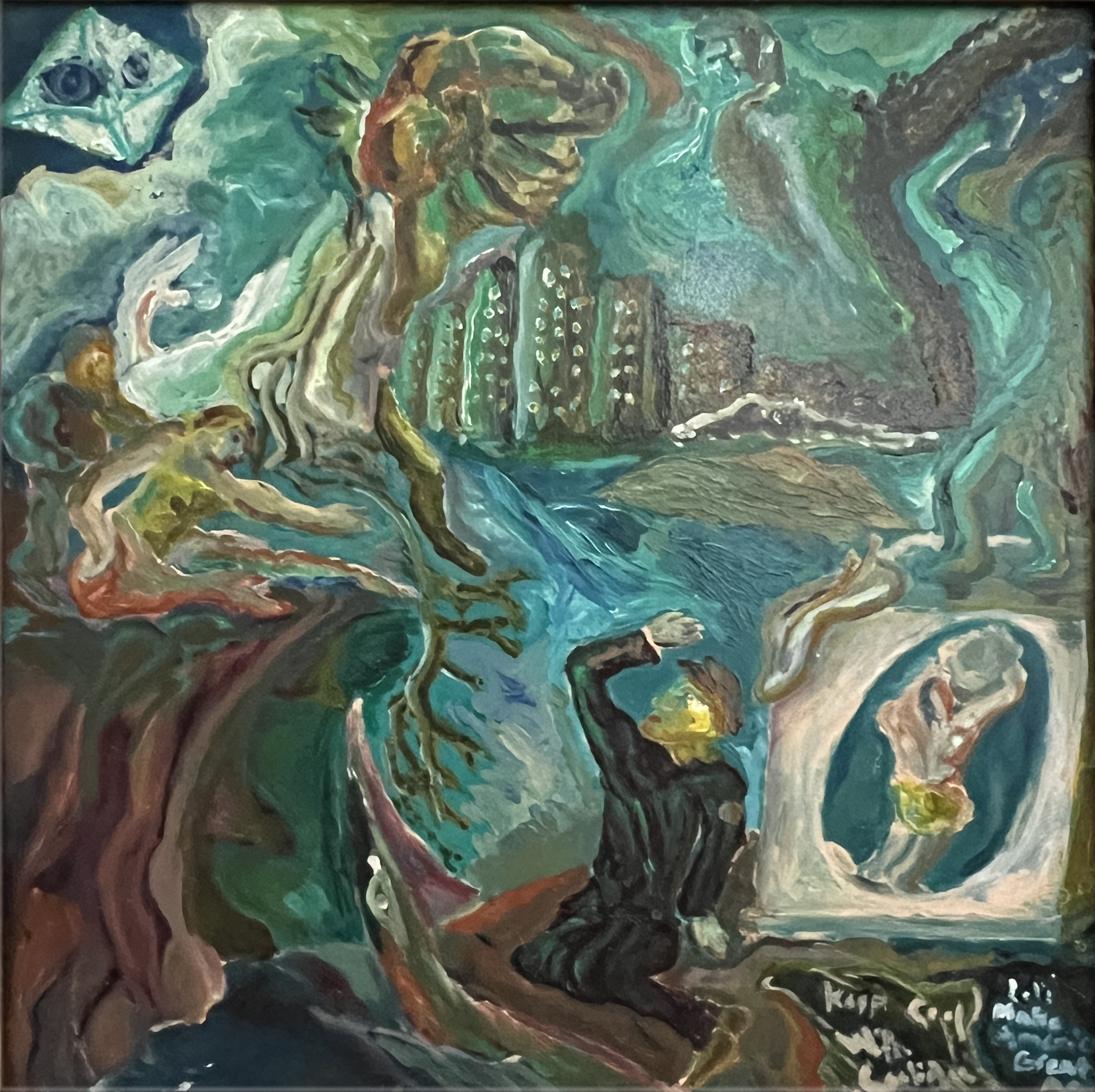
Art Statement
Like any American high school student, I spent some time digesting Fitzgerald’s Gatsby, a man who has a faltering ‘Platonic’ goal. His need to complete what he thinks is his ideal essence or purpose but, in reality, is an artless endeavor makes his life a Sisyphean task. The resurrection of time itself is part of Gatsby’s Sisyphean task since one can not stop or rewind time. With this, the ship of Theseus also comes into play. It shows how one's identity or the identity can never truly be stable, rather it is constantly in flux and changes from day to day. The nineteen-twenties in America which lead to the great precipice of ‘29 have come to be associated with ideas of Manifest Destiny and the American Dream. I, like many before me, have used a Statue of Columbia to stand for American imperialism and the will of many Americans to impose their faulty values on the rest of the world. I also hope you can see the corruption of laissez-faire economics in this image. Laissez-faire, if left unattended like in the 1920s, will more often lead to the reality that one can do a lot of hard work and not even come close to the upper class when there is little to no social safety net. This becomes obscene when it is compared to the way Gatsby becomes rich quickly doing something illegal. Hatshepsut sits in frame, a female pharaoh forgotten by future generations because her successor bulldozed her legacy, shows how such a brightly blazing star can be so quickly quenched and deserted. Finally, like Fitzgerald, I use the color gold as the color of corruption. This is often true in nature as what is fresh, new and alive is green but as life exits, the corpse turns shades of gold before passing into death. However, one must remember that it is only through death, that rotten golden brown, that new green life may grow, and it is only when Gatsby, or any of us, lets go of his previous metaphysical identity, that we may finally be free to pursue the truth.